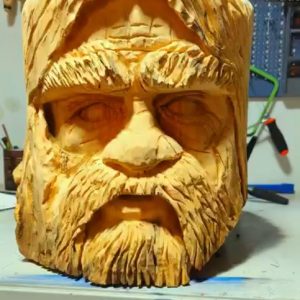
I rarely repeat a subject or follow an existing pattern. I prefer to begin with a concept that interests me — a figure from mythology, folklore, history or imagination — and then explore what makes that subject emotionally interesting to me.
Finding the story
Before I start carving, I spend time looking into the history behind the character or theme.
I try to understand the original story, the symbols around it, and the different ways it has been represented. From there, I look for an angle that feels personal — something that can create emotion rather than simply reproduce a familiar image.
That angle becomes the starting point of the sculpture.
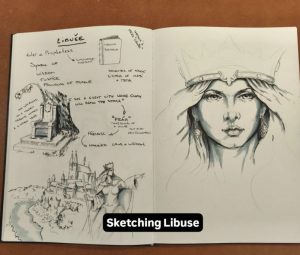
Sketching the first idea
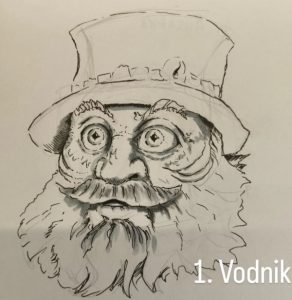
The first physical step is usually a drawing.
I sketch the character on paper, most often with black fineliner pens. These sketches are not technical plans. They help me find the expression, proportions, silhouette and general atmosphere I want to explore.
The drawing gives me a direction, but it is never a final instruction.
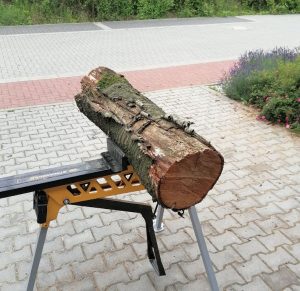
Choosing the wood
Then comes the search for the right piece of wood.
Its size, grain, shape, imperfections and existing cracks can all influence the final sculpture. Sometimes I already know exactly what I am looking for. At other times, the piece of wood itself changes the way I imagine the character.
This is where the original concept begins to meet the material.
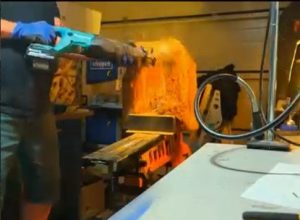
Blocking the form
The first stage of carving is physical and fast.
I remove the largest amounts of material using heavier tools such as a chainsaw, axe, hammer and chisels, together with coarse rotary carving tools.
At this stage, I am not looking for details. I am trying to find the main volumes: the direction of the head, the shoulders, the silhouette, the dominant planes of the face or body.
This is the moment when a block of wood begins to become a figure.
Refining the sculpture
Once the main form is established, the pace changes completely.
I work much more slowly with chisels, a Dremel and finer rotary tools. Gradually, I refine the anatomy, expression, folds, textures and smaller details.
This is usually the longest and most important part of the carving process.
It is also the point where the sculpture often begins to move away from the original sketch.
Letting the wood change the idea
I never expect the final sculpture to be an exact three-dimensional copy of my drawing.
As I carve, I discover the grain, knots, cracks and natural movement of the wood. Proportions change. Expressions evolve. Sometimes a feature I planned disappears completely, while something unexpected becomes central to the piece.
I like this part of the process.
The sketch gives me the direction, but the wood has its own character. The final sculpture comes from the meeting of both.
Finding the name
Somewhere during the carving process, the piece usually finds its name.
The working concept may begin very simply — a Golem, a mythological god, a legendary figure — but I rarely keep that as the final title.
As the character develops, I try to find a name that reflects the particular emotion, story or interpretation that emerged during the carving.
For me, the title is part of the artwork.
Sanding by hand
When the carving is finished, I begin the sanding.
I do much of this work by hand. It is a slow and sometimes demanding process, but it gives me much more control over the shapes I created during carving.
Aggressive machine sanding can quickly flatten an expression or soften an important edge, so I prefer to take my time.
The aim is not to make the sculpture perfectly smooth. I want to refine the surface while keeping the marks, planes and character of the carving.
Fire and surface
I often burn parts of the wood.
Burning helps protect the surface, but I also use it as an artistic tool. It can deepen shadows, reveal the grain and give stronger contrast to particular areas.
Depending on the sculpture, I may burn the whole piece or only selected details.
Bases and supports
Some sculptures need their own base or support.
When necessary, I design and build one so that it feels like part of the sculpture rather than simply something holding it upright.
The way a piece stands, its height and the angle from which it is viewed can strongly affect its presence.
Colour and expression
I sometimes add acrylic paint to selected details.
The eyes are particularly important to me, because they often determine the expression and emotional presence of a face.
I try to use colour carefully. I generally want the sculpture to remain visibly made of wood, so most of the surface stays natural.
The paint should support the carving, not cover it.
Protecting the finished piece
The final stage is oiling and protecting the sculpture.
Oil brings back the depth and warmth of the grain and often reveals details that remained almost invisible during carving.
Depending on the piece and its intended environment, I may also use additional protective finishes.
Only then does the sculpture feel complete.
From an idea to a character
My process is never completely fixed.
Some pieces change very little from the first sketch. Others become something quite different along the way.
That uncertainty is one of the things I enjoy most about carving.
I begin with a story and an idea, but I never know exactly who will emerge from the wood.